
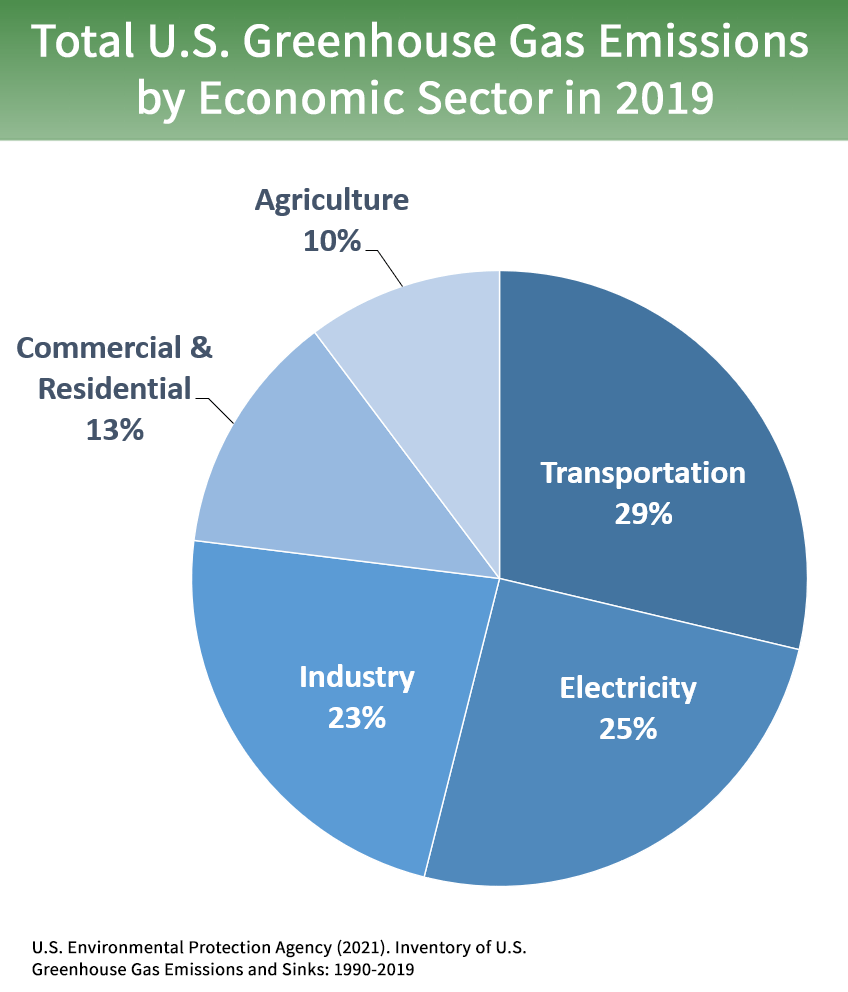
As the world looks to ever more sustainable transportation options the field of micro mobility is one of the fastest growing. In fact:
data collected on one-way household trips show that the majority (59.4%) of vehicle trips were less than six miles. In fact, three-fourths of all trips are ten miles or less. Another 8.4% of trips were between 11 and 15 miles, with the three longer trip distance categories about 5% each
Of those trips, many were with only one occupant. Clearly the family minivan or a large pickup are overkill and a daily attack on our environment. In the booming world of micro-mobility there are many environmentally friendly solutions. The choice of which option is best often comes down to three things:
Distance
What needs to be carried
and Cost
Scooters, both push and electric do an amazing job of the last mile range
Bicycles meet the needs of greater distances 5-10miles
Cargo Bikes also meet the needs of greater distances 5-10miles and have the advantage of being capable of hauling all sorts of things, shopping, mail, deliveries, kids, dogs largish trees even small businesses like coffee stands, ice cream vending, and more.
all of the above solutions however are limited in the case on inclimate weather.
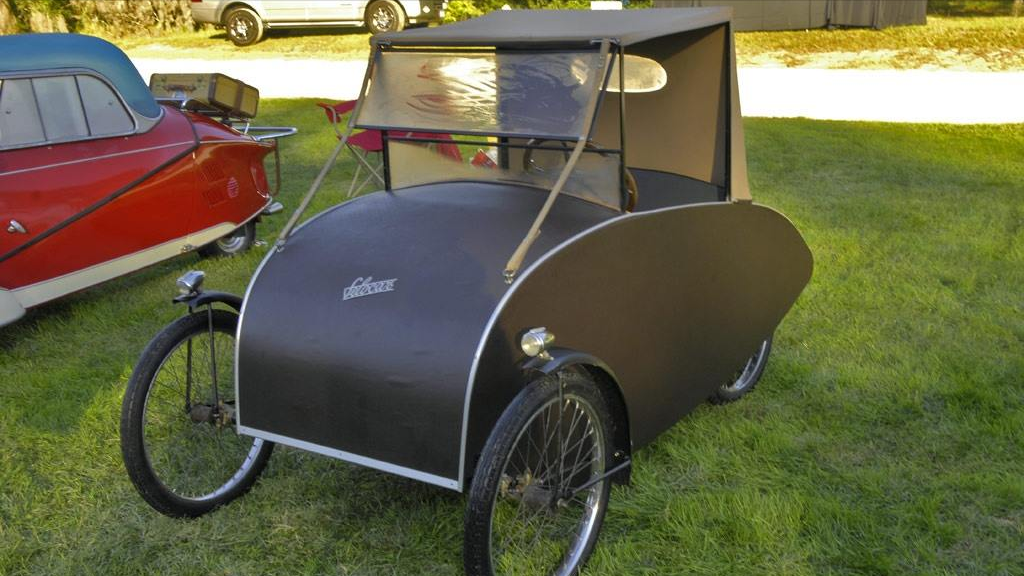
This is where Velomobiles fit in. The Velomobile is an enclosed multi-wheel bicycle which offers safety and shelter options that are lacking from the previous three micro-mobility considerations. The velomobile is hardly a new idea, invented by Charles Mochet in 1923 for his son Georges. Originally the velomobile was intended as a safer option than bicycles for children. Velomobiles, however, grew rapidly in popularity even for adults when petrol became almost unobtainable during World War II, 1939–1945.


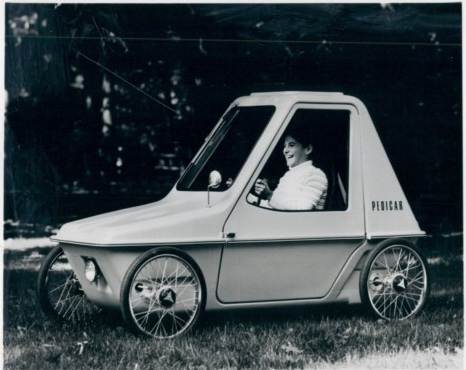
In 1971, again in response to a shortage of gasoline, new velomobiles were developed, one of the best of which was the Pedicar. Invented by Robert L. Bundschuh, a 38 year old ex-Gyrodyne aircraft engineer and his coworker, Lionel Martin, in 1972 and produced in Connecticut, the Pedicar featured a spectacular custom drivetrain, fully mechanical with five forward speeds and a reverse gear (sadly lacking in most modern velos). It was also very affordable. It could be purchased for $500 which would be the equivalent of $3,431.46 in 2022 or about half the cost of the most affordable production velomobile on the market today.
Today, there are literally hundreds of modern variations on the concept of Mochet's velomobiles. Just as the lack of gasoline led to the boom for the original velomobiles, today there is a new boom coming from those who care about the #climatecrisis and are looking for transportation options that are not dependent on fossil fuels. Be it a lack of fossil fuels or a desire to end our dependence on them Velomobiles are one of our best options.

So with all that velomobiles have going for them, what's the downside?
In a word?
COST
You'd think that everyone would want one. With the environmental and cost advantages (no taxes, insurance, license or registration required) of a velomobiles and the fact that they are capable of replacing a majority of the daily driving, what's not to like? Modern day velomobiles are indeed marvelous feats of engineering. But aerodynamics, custom transmissions, and carbon fiber or fiberglass monocoque chassis, while they make impressive speeds possible, come with a price tag that is five to ten times the cost of a used fossil fuel dependent car.
To help address the Climate Crisis do we really need suppository-shaped expensive velomobiles capable of speeds as high as 60 km/h (37 mph)?
The answer is NO
After all, what's the point of being able to go 37 mph (60km/h) when the average city traffic moves at 9.32 mph (15km/h) and in many cities it's even slower:
According to a 2013 analysis by INRIX, which looked at the worst corridors in Europe and North America, the following cities had corridors with single-digit driving speeds:
- Austin, Texas 9,6 km/h (6 mph)
- Cincinnati, Ohio 14,4 km/h (9 mph)
- London, UK 14,3 km/h (8,9 mph)
- Los Angeles 12,8 km/h (8 mph)
- Milano Italy 9.1 km/h (5.6 mph)
- New York City 12,5 km/h (7,8,8 mph)
- Roma Italy 8.5 km/h (5.2 mph)
Source: Scientific American
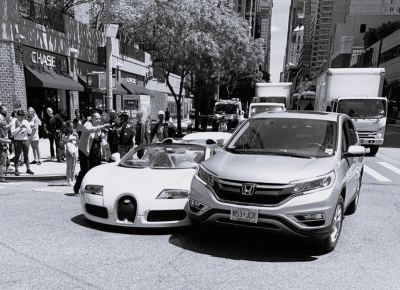
“To put that into perspective, the Bugatti Veyron Super Sport (SS) has a top speed of 431.072 km/h (267.856 mph) but if traffic is at 12 km/h you'd certainly get to your destination faster on a bicycle.
Did you know that "switching 7.5% of diesel vans to e-cargo bikes could have a greater impact than eliminating all UK domestic aviation emissions" ? Read more here
- Trains 425 kpl (1000 mpg)
- Honda civic 17 kpl (40 mpg)
- Pickup truck 8.5 kpl (20 mpg)
- Prius hybrid 21 kpl (50 mpg)
- Electric car 42.5 kpl (100 mpg)
- walking the energy equivalent works out to 23kpl (55mpg)
- traditional (no assist) bicycle 115 kpl (270 mpg)
- electric assist cargo bikes 204 kpl (480 mpg)
- commuter electric assist bikes 242 kpl (570 mpg)
- but if you charge with solar panels and eat local food the efficiency of an e-cargo bike jumps up to the equivalent of 553 kpl (1300 mpg) making it the most efficient form of transport.
a car emits 150 g of CO2 per passenger km (240 g of CO2 per passenger mile)
public transportation emits 50-110g of CO2 per passenger per km (80-176g of CO2 per passenger mile)
bicycle with electric assist emits 2-5 g of CO2 per passenger per km (3.2g-8g emitted per passenger mile)
The Model T Ford, the Fiat 500, the Beetle, the Citroen 2CV were all huge successes because they were designed to meet the needs (and budget) of the masses. If we're going to get serious about the climate crisis we need solutions that are not just accessible to the few but to everyone.
Our goal is to return velomobiles to their simple origins and with the advantage of some modern engineering provide the world with the a velomobile for everyone:
a folk's velo.
How are we doing this?
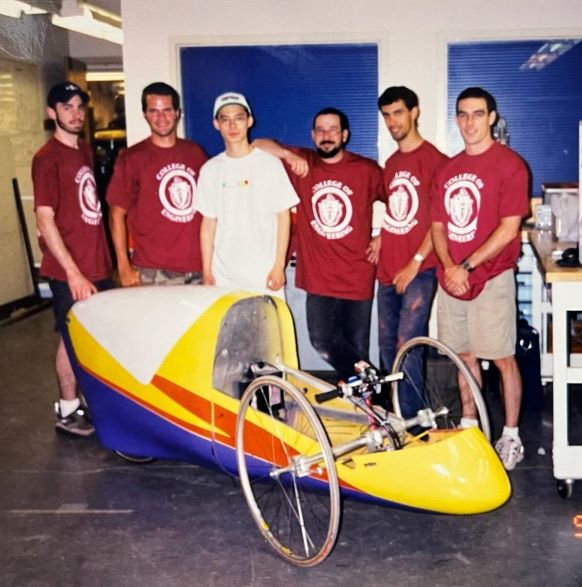
Nathaniel Mulcahy is an engineer and inventor with decades of industrial and ecological design (fellow in the center with the beard in this photo taken in 1999). Design parameters are currently focused on needs that many other city focused velomobiles do not address. The base unit of the FolksVelo is designed to run predominantly without e-assist and uses a preponderance of off the shelf components and will be available without an outer shell. Higher cost FolksVelos include custom drivetrains, multiple suspension options (including titling suspension), fully enclosed shells e-assist. A full feature prototype is expected to be revealed at SPEZI 2026 in Lauchringen Germany.
Our Logo

Our logo is a tribute to the public rail systems of Italy in the 1970ies.

We see velomobiles as a way to make public transportation like trains even more sustainable and envision the interdependence of rail and velomobiles as a way to reduce emissions and city traffic.
Design Parameters
Cost is certainly the primary driver behind Folksvelo but it is not the only consideration which were the drivers behind our design other considerations included:
Safety
while keeping out the the elements an additional huge benefit of a fully enclosed vehicle is safety. Think of the Folksvelo like a bicycle helmet that protects not just your head but your whole body... and it has the added bonus of not causing helmet hair
Size
to maximize safety size was and overall dimensions were key drivers. the Folksvelo is designed to be large enough to hold one person and some cargo safely with future iterations already in the works for a two person version. The dimensions we arrived at were a careful balance of maximum size for visibility and storage but small enough to be able to fit through a standard doorway (making indoor storage possible for more people even those who may not have a garage) and travel in bike lanes
Number of wheels
The velomobile market in the EU has a great
many brilliant 4 wheeled solutions but, in the USA, Ireland and Australia, to meet the requirements for being classified as a bicycle they are limited to three wheels. While this did pose unique design challenges to assure maximum stability it did allow us for a much more maneuverable vehicle which we feel increases safety especially when maneuvering around fossil fuel vehicles who are stuck in their daily traffic jams. Additionally, by focusing on a three-wheeled design as our first velomobile we have developed a solution that is legal in any country.

Shape
Finally shape was a huge factor in our design. Many modern day velos look more like the Dymaxion than a conventional utilitarian vehicle and while as engineers we appreciate the fluid dynamic advantages we see the unconventional shape as being an obstacle for many. If we are going to help the planet we need to make a vehicle that is more universally acceptable. The Folksvelo will certainly not win any beauty contests (although we happen to think it's very cute) nor will it look like a supercar but it will instantly be recognizable as a cousin to the ever-so-handy hatchback that has become ubiquitous around the globe. The shape may come across as a bit boxy but that helps keep the cost of manufacturing lower and to be honest, the speed at which most city traffic moves means the aerodynamic advantages of a more streamlined shape would be negligible...after all the Folksvelo is not designed to win the Tour-de-France we're just trying to get people to the train station or give them a fun, healthy, eco-friendly way to have a quick run to the store for some groceries or takeout